





I’ve spent the past week researching the most active prediction market sites and apps so our team could compare them properly. Between AI search tools, Google deep-dives, and a few calls with the brands themselves, I pulled together the insights that matter most and put them all on one page: every active platform, its bonuses, app ratings, how the pricing works, and where it is legal.
| Name | Website | Bonus | Launch | iOS | Android | AppStore Ratings | PlayStore Ratings | API |
|---|---|---|---|---|---|---|---|---|
| Polymarket | https://polymarket.com/ | ❌ | 2020 | ✅ | ✅ | 4.7 | 2.7 | ✅ |
| Kalshi | https://kalshi.com/ | ✅ | 2021 | ✅ | ✅ | 4.7 | 4.5 | ✅ |
| PredictIt | https://www.predictit.org/ | ✅ | 2014 | ❌ | ❌ | No App | No App | ✅ |
| Manifold | https://manifold.markets/ | ✅ | 2021 | ✅ | ✅ | 4.5 | 4.6 | ✅ |
| Crypto.com | https://web.crypto.com/ | ✅ | 2016 | ✅ | ✅ | 4.7 | 4.4 | ✅ |
| Opinion trade | https://app.opinion.trade/ | ❌ | 2025 | ❌ | ❌ | No App | No App | ❌ |
| Hedgehog | https://www.hedgehog.markets/ | ❌ | 2021 | ❌ | ❌ | No App | No App | ❌ |
| Fanduel | https://www.fanduel.com/predicts | ✅ | 2024 | ✅ | ✅ | 4.8 | 4.5 | ❌ |
| Futuur | https://futuur.com/ | ❌ | 2021 | ❌ | ❌ | No App | No App | ✅ |
| Probable | https://probable.markets/ | ❌ | 2025 | ❌ | ❌ | No App | No App | ❌ |
| Augur | https://augur.net/ | ❌ | 2018 | ❌ | ❌ | No App | No App | ✅ |
| Underdogfantasy | https://app.underdogfantasy.com/ | ✅ | 2020 | ✅ | ✅ | 4.8 | 4.6 | ❌ |
| Forecastex | https://forecastex.com/markets | ❌ | 2024 | ❌ | ❌ | No App | No App | ✅ |
| Predict | https://predict.fun/ | ❌ | 2024 | ❌ | ❌ | No App | No App | ✅ |
| Robinhood | https://robinhood.com/ | ❌ | 2024 | ✅ | ✅ | 4.3 | 4.2 | ❌ |
| Sx Bet | https://sx.bet/ | ✅ | 2022 | ❌ | ❌ | No App | No App | ✅ |
| Smarkets | https://smarkets.com/ | ✅ | 2010 | ✅ | ✅ | 4.8 | 3.9 | ❌ |
| Limitless Exchange | https://limitless.exchange/ | ❌ | 2025 | ❌ | ❌ | No App | No App | ❌ |
| Myriad | https://myriad.markets/markets | ❌ | 2025 | ❌ | ❌ | No App | No App | ❌ |
| Seer | https://app.seer.pm/ | ❌ | 2024 | ❌ | ❌ | No App | No App | ❌ |
| Rain | https://www.rain.one/pred | ❌ | 2025 | ❌ | ❌ | No App | No App | ✅ |
| Alphaarcade | https://www.alphaarcade.com/ | ❌ | 2025 | ❌ | ❌ | No App | No App | ❌ |
| Trueo | https://trueo.com/ | ❌ | 2025 | ❌ | ❌ | No App | No App | ❌ |
| Punk Coffee | https://punk.coffee/markets | ❌ | 2025 | ❌ | ❌ | No App | No App | ❌ |
| Spindash | https://spindash.gg/ | ❌ | 2025 | ❌ | ❌ | No App | No App | ❌ |
| Belief Market | https://app.belief.market/ | ❌ | 2025 | ❌ | ❌ | No App | No App | ❌ |
| Foliogames | https://foliogames.co/ | ✅ | 2025 | ❌ | ❌ | No App | No App | ❌ |
| Precog Market | https://core.precog.market/ | ❌ | 2024 | ❌ | ❌ | No App | No App | ❌ |
| Bodegamarket | https://v3.bodegamarket.io/ | ❌ | 2025 | ❌ | ❌ | No App | No App | ❌ |
| Azuro | https://azuro.org/ | ❌ | 2025 | ❌ | ❌ | No App | No App | ❌ |
| Roobet | https://roobet.com/predictions | ✅ | 2026 | ❌ | ❌ | No App | No App | ❌ |


Vol: 2.6M

Vol: 697.1K
Most don’t. As of May 2026, 10 platforms offer a new-user incentive.
The format usually mirrors what you’d see at a sportsbook: a deposit-match (your first deposit credited with additional “bonus cash”) or a cashback-style offer that unlocks as you deposit and wager. Terms vary, but expect minimum deposits, time windows, and rules on how the bonus can be used or withdrawn.
List of Prediction Market Sites With a Welcome Offer
Sometimes, but not always. The two products work differently. A sportsbook sets the odds and bakes in a margin (the vig) by shading both sides of the market. A prediction market is closer to an exchange: users trade against each other and the price moves with demand. A “Yes” share trading at 0.62 implies a 62% probability before fees.
That structural difference means prediction markets can offer sharper prices when liquidity is strong and many users are trading the same outcome. On quieter markets the spread between buy and sell widens, and trading or settlement fees can erase any edge.
How to compare fairly: convert sportsbook odds to implied probability, strip out the vig, then compare to the prediction market price net of fees and spread.
In practice, prediction markets win on big, liquid markets: major elections, championship games, and large headline events. Sportsbooks remain more reliable on smaller markets, props, and anything where you need to enter or exit quickly during fast news.
For sports in 2026, Kalshi is the strongest pick. It has the volume: reportedly over $1 billion in trading on Super Bowl Sunday and the user base needed to keep large markets liquid, with the Financial Times reporting growth from around 600,000 to 5.1 million users in roughly a year. The mobile experience, promotional offers, and depth of headline markets put it closest to a mainstream sportsbook feel.
Polymarket remains the stronger choice for broader, internet-driven markets like politics, culture, and world events. For sports specifically, though, Kalshi wins on liquidity and reach.
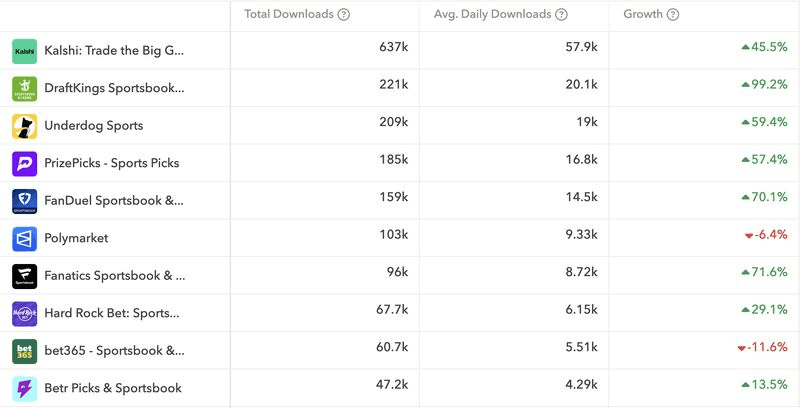
Prediction market apps now compete directly with traditional sportsbooks on download volume. Kalshi leads the category at roughly 57.9k daily downloads, ahead of DraftKings (20.1k), Underdog (19k), PrizePicks (16.8k), and FanDuel (14.5k). Polymarket sits at around 9.33k, between Fanatics (8.72k) and Hard Rock Bet (6.15k), and above bet365 (5.51k).
The two product categories are converging. Sportsbooks are adding trading-style features; prediction markets are launching big headline pools, sign-up offers, and major-event promotions that look like a sportsbook playbook. The competitive question for 2026 is no longer pricing. It is which app owns the sports-betting habit on a user’s phone.
A 2026 snapshot of 40 countries where English is an official first or second language, grouped into three buckets:
In these countries, prediction markets are generally treated like gambling or betting (or sit in a grey area): legal only with the right local licence. Most global crypto prediction markets either geoblock or operate at risk.
A few sources stood out while researching this guide. If you want to dig deeper, these are the ones I came back to most often:
Video: Modern Gambling & the Rise of Prediction Markets…
Website: Defillama
Reddit trend comparison of five prediction market
Reddit prediction markets
Igaming article
If you take only three things from this guide: prediction market sites price events as tradable probabilities rather than fixed odds, only a handful currently offer a welcome bonus, and your best platform depends on what you trade. For liquid sports markets in 2026, Kalshi leads on volume and reach; for politics and world events, Polymarket is still the deepest. Everything else comes down to your country’s rules and whether the app you want is even available to you.
Want to weigh these platforms against regular sportsbooks before you commit? Compare licensed options side by side on our main bookmaker list, and if you are in Europe, check your local rules first with our guide to European gambling regulators.
Prediction markets are platforms where users trade on the outcome of real-world events. Instead of placing a bet against a bookmaker, you buy and sell positions on a yes/no question — “Will Team A win?”, “Will X happen before a certain date?” — and the price reflects the collective probability the market assigns. The more traders, the more accurate that price tends to be.
Yes, with conditions. Under the federal commodities framework (the CFTC and the Commodity Exchange Act), a platform can be a regulated “event contracts” marketplace and operate nationwide. Kalshi, for example, is a CFTC-designated contract market.
Where it gets contested is sports and certain real-world events. Several states argue that sports event contracts function as sports betting and require a state gaming licence, which has triggered lawsuits and state-level rulings against operators like Kalshi.
Treatment also varies by platform. In 2022 the CFTC took action against Polymarket for offering event-based binary options without registration. A properly structured, federally regulated platform is legal nationwide, but availability still shifts by contract type and by state.
Closing line value measures whether you entered a position at a better price than where the market ultimately closed. If you bought “Yes” at 0.55 and the market settled at 0.65, your CLV is positive — you got in cheaper than the final consensus. Positive CLV over time is a stronger signal of skill than any individual win or loss, because it shows you consistently beat the market price.
On most prediction markets, the share price is the implied probability. A “Yes” share trading at 0.62 means the market estimates a 62% chance the event happens. The formula is Probability (%) = Price × 100, so 0.10 = 10%, 0.50 = 50%, 0.78 = 78%. Fees and the buy/sell spread shift the true implied probability by a small amount, but for most purposes price and probability are the same number.
Three main costs:
Trading fee — a percentage or fixed charge taken when your order matches, similar to an exchange commission.
Spread — the gap between the buy price and the sell price. Often invisible on the surface but a meaningful cost on low-liquidity markets.
Settlement fee — some platforms charge when the market resolves and winning shares are paid out, or on withdrawal.
On large, liquid markets the spread tends to be tight and explicit fees are the main cost. On thin markets the spread is usually the larger of the two.
They are different products. Sportsbooks are built for betting: fixed odds, simple slips, parlays, promotions, and a bookmaker on the other side of every wager with vig baked in. Prediction markets are built for trading: prices move with order flow, positions can be exited before the event resolves, and the cost is the spread plus fees rather than a built-in margin.
A sportsbook fits quick bets, parlay structures, and familiar odds formats. A prediction market fits taking advantage of price movement, trading in and out of positions, and reacting to news on liquid markets.

